Thursday, January 11, 2018

Chi Elias Assessment Trip: Antigua & Adiós Guatemala!

Our trip is finally over! Early this morning our team landed back in the United States, but not before a fun day in Antigua, Guatemala! On Tuesday, we started with a hike up the Pacaya Volcano. We saw lava, more volcanoes, volcanic ash, and roasted marshmallows over a hot spot in the volcano!
Our team on top of the Pacaya Volcano
 After that we walked around Antigua and visited their many artisan marketplaces, some beautiful churches, huge plaza, iconic arch, and delicious food. 

Nim Po't Marketplace
Our team under the Antigua Arch
Before leaving on Wednesday we took a quick hike up Cerro de la Cruz and checked out the huge cross and the extensive view of Antigua and its volcanoes.
Cerro de la Cruz
+After the climb, we checked out some more markets and headed back to Guatemala City. There, we met Carlos' family again and had more Pollo Campero. We then had to get back to the airport so we could catch a plane to Panama City and then another one back to New York City. We spent most of today recuperating, sleeping, and preparing to return to classes on Tuesday.
Just a small part of the community in front of Chi Elias
This trip was such a great learning experience for the whole project. We got lots of good information about the Chi Elias school, their community, culture, and how to proceed with the project. I can't wait to get back to planning our next steps and getting the school built! Hopefully, after many meetings and a lot of hard work, we finally get 2 new classrooms, an office, an event space, and a fence for the students at Chi Elias. With Engineers Without Borders, we can improve their future.
Dream team!
Lastly, I'd like to thank our wonderful team: Angela, Stefan, Carlos, and Brad, who all dedicated so much time and energy into a cause we all believe in. I'd also like to say a special thank you to Allison, out other project lead, who unfortunately could not join us on the trip. She, along with the rest of our project back at Rutgers, has worked so hard to make this trip a reality for us. I'd also like to thank you for keeping updated on our trip and for supporting our project! Look out for our next trip!

In the meantime, check out what we're up to at the links below!
Website: https://ewb-rutgers.com/
Facebook: https://www.facebook.com/ewbusarutgers/
Instagram: ewbrutgers

Monday, January 8, 2018

Chi Elias Assessment Trip Day 6: Adiós Chi Elias

Today was a very emotional day as we said adiós to the kids at Chi Elias. First, Jeanny and the mayor of Momostenango arrived and we had a brief meeting together with parents of students at Chi Elias to evaluate the municipality's role in the project. We also presented the teachers with a board we made  to be hung up somewhere around the school to remind them of our Engineers Without Borders and also to post updates on the project.

Angela and Carlos presenting the EWB-USA Rutgers board for Chi Elias
As today was their first day back after a long break, the kids were mostly playing around the school, so we took the opportunity to get to know them better. We learned they really like basketball, games, and pictures!
Lesley and Stefan playing rock, paper, scissors
An intense game of basketball.
These girls followed me around all afternoon asking for "¡Una foto!"
Eventually we did have to say goodbye to hopefully return sometime soon with next steps their new school. After that, we left for Antigua and are now staying in a hostel for the rest of the trip.  

We have a lot planned for tomorrow so until then, ¡buenas noches!

Christina

Sunday, January 7, 2018

Chi Elias Assessment Trip Days 4 & 5: A Weekend in Momostenango


Since it is a weekend, nobody was at Chi Elias so we took some time to explore Momostenango. On Saturday, we set out to find good local hardware stores and their prices so we could more accurately analyze the cost of this project. 

Inside a hardware store in Momostenango, Guatemala. They really packed everything in there!
To ensure we weren't being overpriced for being tourists, we brought a team of some members of the Chi Elias community to show us around. We were only expecting a tour around some hardware stores, they ended up showing us all around Momostenango! We explored a natural canyon, struggling to keep up with some of the older locals. it wasn't until after we climbed all up and down each crevice that we found out it was a Mayan ruin!
Riscos de Momostenango
This is great! But how do we get down?
We all then went out to lunch at a local eatery that had cow tongue on the menu. I opted for chicken soup and rice but Stefan and Carlos were brave and decided to try it! We also were taken to a natural water park with pools, waterfalls, and hot springs. The water was beautiful and clear with some local kids enjoying their weekend splashing around. There was also a station for people to wash their clothes with clean water flowing over wash boards. It was a beautiful example of good engineering in a place that greatly benefits from it.
Water is life.
We then had dinner around town, first having pupusas, or fried tortillas stuffed with cheese and topped with cabbage and salsa. They were delicious, with so much love put into every pupusa as it was made before our eyes. We then decided to stop by a store with a taco truck in it. They had tacos and tortas so big and delicious that we returned for lunch and dinner today too! Although Stefan got us lost on the way there so now he has been reduced to our Solar-Powered Navigator in that he only knows his way during the day.
Tacos from the place across the street from the barber shop.
Today was Sunday, or Market Day across Guatemala. This meant the sidewalks turned into stores and the streets flooded with people. We made the mistake of trying to run a quick errand and nearly drowned in the crowd. It was a thrill to see all that Momostenango had to offer from grains and meats to bags and shoes to chickens and cows all displayed in the center of town. 
I tried to stop for a moment to capture Market Day before getting swept away in the crowd.
We returned to the hotel to discuss what we've learned about Chi Elias so far and how to proceed with the next couple of days, weeks, and months with the project. We finished the day with more tacos and the Golden Globes, getting a much needed taste of American entertainment. 


We have a long day ahead of us tomorrow! 

So until then, ¡buenas noches!

Christina

Friday, January 5, 2018

Chi Elias Assessment Trip Day 3: Meetings

Stefan and Angela recording some data 
Today in Guatemala, we took some more measurements of Chi Elias and met with some parents from the school. Napoleon told us that unfortunately, due to other events happening in the community, only about 10 parents would be able to make our Q&A session. However when parents started to arrive, we had to move the meeting from inside to outside due to how many people showed up!

Some of the parents and students of Chi Elias. In total, about 50 people came to our Q&A session.
Our engineers from the EWB Guatemala office, Jeanny and Waleska, also came by. We discussed who Engineers Without Borders is, how the project will happen, and what to expect from us throughout the project. We mentioned how we will only come by every so often, but just because they don't see us doesn't mean we've forgotten about them. We will still be working on their school every week at Rutgers. We also explained to them how we will expect from them a 5% contribution  to the project in the form of materials. This includes any wood, concrete, or other tools we may need. Although this was initially a concern for the community, we encouraged them to leave the worrying to us for now as we are there to help them.
Our team with Jeanny and Waleska on the official EWB truck
The teachers then invited us for a lunch of a traditional Guatemalan soup, tea, and of course more oranges. The soup had beef, vegetables, and noodles and the tea was made with corn, barley, and cinnamon. Both were absolutely delicious. Napoleon told us, "Although we do not have much, God is big" as Carlos loosely translated to us. Brief appreciation for the whole team: Carlos has been an amazing interpreter, Angela a wonderful leader every step of the way, Stefan a brilliant navigator, and Brad an endless source of wisdom. Our success on this project is thanks to the work of everyone on the team.
Enjoying our traditional Guatemalan lunch
After lunch, we had a meeting with the teachers to discuss some technical options for the project. This included details such as how to level the land, where the office would go, and how to optimize usage of the event space. Fortunately, the teachers did agree with most of our ideas with constructive feedback on some. We had a productive, supportive, cooperative meeting with the community of Chi Elias which is more than we could ever hope for in this project. With the support from the community, as we have been so careful to generate, will allow us to fully improve the community with the best of our abilities.

We have a busy weekend ahead of us, so ¡buenas noches!

Christina

Thursday, January 4, 2018

Chi Elias Assessment Trip Day 2: Chi Elias

Today we finally got the opportunity to see the Chi Elias school! We woke up early this morning, had breakfast at our hotel, and discovered an awesome balcony that overlooks Momostenango.

Dream team (minus Carlos) checking the view

We then ventured an additional 40 minutes in another van to Chi Elias, with one of the schoolteachers, Napoleon, following us on a motorcycle. We were welcomed into the school with fresh oranges, then had a brief meeting with the teachers and a few community members about our expectations for the project. They had a few short requests: 

Part of the exterior of Chi Elias school
  • 2 new classrooms
    • They currently have 6 classrooms, one for every grade. Two of the classrooms were poorly built and the moisture in the rooms is giving children respiratory and gastrointestinal problems.
  • An office for the principal
    • Currently the principal holds important meetings in the first grade classroom. This is where she teaches and it is also the nicest and safest room in the school.
  • A fence completely surrounding the school 
    • The government started a project in the past to put a fence around the school. However, they only finished less than half of it. A fence would protect the students from wild animals and also dangerous terrain.
  • An event location
    • The school hosts many important community events, including Mothers' Day and Kids' Day celebrations. They would like a large venue to host these events.
We have quite a few tasks on our plate! However with the community's enthusiasm and their willingness to put some hard labor into the project, it definitely seems possible within the next few years. The teachers have such a dedication to their students that shows in the students' achievements. Napoleon told us that usually out of a Chi Elias graduating class 25 students, 8 will go on to secondary school for 7th, 8th, and 9th grade, compared to the local average of 1, if not 0, continuing with their education.


Napoleon telling us a little about Chi Elias

The school does not have much, but they do so much with what they do have. Napoleon packs classes in reading, math, natural sciences, social sciences, debate, physical education, English, and so much more into every week!  The students are so smart, however, due to financial issues, very few have the opportunity to apply this knowledge. We're so excited to enhance their education and hopefully make this easier for students to succeed later in life.

Observing the back of Chi Elias. There's a steep drop and no fence!


After we got some background on the school, we toured the buildings and surveyed the land. Some of the classrooms were very well built, however some were somewhat improvised. It seems that in addition to adding new buildings, we may have to do some repair to the old ones. Chi Elias doesn't  have much land, so adding four new buildings might be tight, but we're thinking of creative solutions to present to the community leaders tomorrow. The land, being in the mountains, is also very sloped and rocky. We will thus also have to be creative with how we level the land before building. There's some good engineering happening!

Some of the students and parents of Chi Elias who came by to say hi to us today. Hopefully, they will benefit from new classrooms sometime in the near future!

These students know English, Spanish, and K'iche' (their native language) by 5th grade. Today, I forgot the word for "May" in Spanish.

After we finished our technical assessment, we were able to meet with the students of Chi Elias. They don't return from their holiday break until Monday, but we were so excited that they came by this afternoon anyway. We talked, exchanged vocabulary and songs in our different languages, and played soccer! Apparently Guatemalan children are very good at soccer. They beat us good: 2-0 before thankfully our van came to pick us up and we had to end the game early.

Tonight we ate dinner at a "pizza" restaurant, walked around Momostenango a little, and hopefully will go to sleep early to prepare for another early day tomorrow.

Until then, Buenas Noches!

Christina

Wednesday, January 3, 2018

Chi Elias Assessment Trip Day 1: Arrival

Today our travel team embarked on our very first trip to Totonicapan, Guatemala! Over the next week I'd like to take you through our journey to assess some new classrooms at Chi Elias elementary school. Our travel team includes our fearless lead Angela, our educational lead Stefan, our leader in all things Guatemala Carlos, our wonderful mentor Brad, and myself.

Our journey to Chi Elias started at Rutgers at about 9pm on Tuesday, January 2nd where we met up to head to JFK International Airport. From there, we flew to Panama and hung out at their airport for a few hours while we waited for our flight to Guatemala. Airport food turned out to be more expensive than we anticipated, so Carlos decided to snack on his hoodie instead.
Just kidding! We bought sandwiches! They were expensive though!

We flew from Panama, landing in Guatemala City around 12:30 Guatemalan time, or 1:30 Rutgers time. Considering we got to JFK around 10:30, this was now 15 hours either in airports or airplanes for us. We were itching to get out and explore Guatemala City! We met up with Brad our mentor, our driver Mario, and some of Carlos' family members! They brought us Pollo Campero, which is like Guatemalan KFC and it was delicious.
Guatemala City! I was still trying to figure out how to take pictures out of a moving car window.

A brief red light allowed me to regain a steady subject.

He drove us in a nice, spacious van 4 hours up into the mountains of Guatemala! We did take a break about halfway through for some delicious chicken and tortillas at a restaurant. As we continued, the roads, though small bumpy at times, took us through some beautiful hilly countrysides.


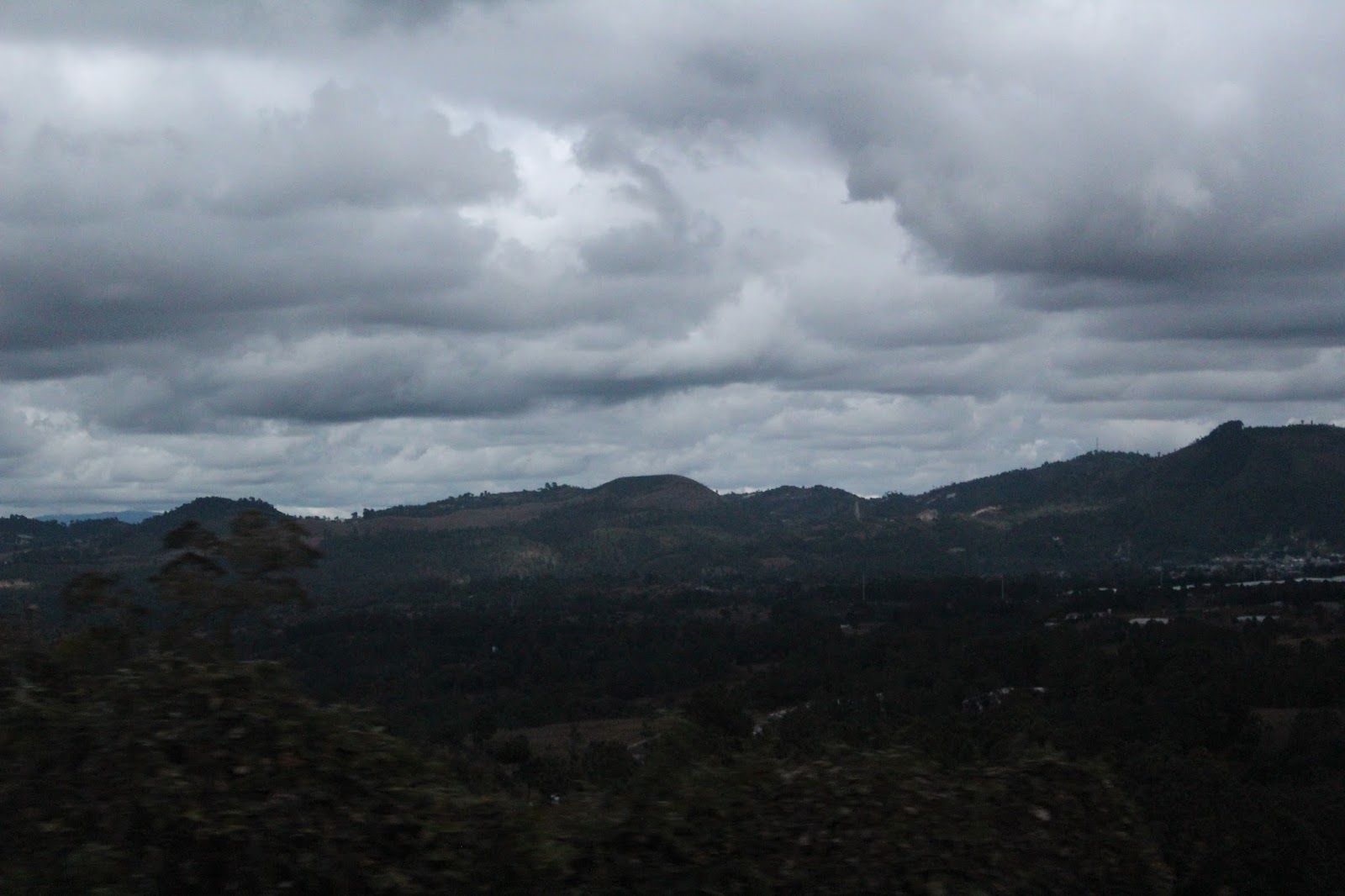
Beautiful scenery of mountains of Guatemala. It wasn't long before some clouds rolled through and it was hard to see any of it! We drove through the busy city of Momostenango, where we are staying at a hotel tonight. We finally arrived at around 6pm on Wednesday, January 3. That adds up 

We need to get to sleep early tonight as we are leaving to go to the school at 7:00am tomorrow! I can't wait to see the students and the school tomorrow. I'll keep you updated!

Until then, buenas noches!

Christina

Thursday, January 21, 2016

The end of the trip at Lake Atitlan.

The weekend around Atitlan was beautiful. Travel team enjoyed showers, beautiful weather, and delicious food around the lake, along with some great souvenir shopping. However, on Saturday, the team met with the NGO (non-governmental organization) that initially started the water project in NSCI, Appropriate Technology Collaborative.

We met up with Monika Goforth, the ATC Guatemalan director. Monika told us about different projects that ATC currently works on, including finding new, cheaper methods of construction, bicycle powered corn shucking, and plastic shredding to help re-purpose the garbage found all around Guatemala. Monika took the team up a short hike to a school near San Marcos in which solar panels were put in to help power the only school for indigenous children in mostly unelectrified communities around the mountain. The team had a lot of fun, learned a lot, and looks forward to partnering more with ATC in the future through new types of projects along with further support for the water project in NSCI.

The team with Monika next to solar panels installed at a local school. 

On Sunday, the travel team sat down for dinner in Panajachel on Lake Atitlan and discussed their favorite and least favorite aspects of the trip, along with the different tasks moving forward. We are all excited for the project in NSCI to be a success and plan to keep working hard this semester toward that goal. The team said goodbye to Guatemala the following day, and we're now all back in New Jersey with thoughts of all that happened fresh in our minds.

~Neha

Finishing the week in NSCI

Dave, Austin, and Ericka drew the short sticks for the Head Tank test the following morning, and met Manuel, the fontanero, up at the tank at 5:30 AM. In a similar fashion to the previous day, Neha, Sandy, and Sam headed up to the tank at around 8 AM to relieve the first team and let them eat some breakfast. While at the tank, Sandy and Dave used Ericka to pick Manual's brains and try to map out where he thought each valve provided water. Before this trip, the team was under the impression that there was one valve per neighborhood in the community, but it was soon discovered that the distribution system piping was much more complicated. The Water Committee is still working to try to give us a map that shows where water flows from each valve at a per house level. This will really impact our analysis of the system.

Picking the brains of Manuel to figure out where each valve is serving.

At around 2 PM that day, the team had a summary of findings meeting with the Water Committee. The team addressed the expectations that the Water Committee provided at the beginning of the week. The Water Committee seemed amazed at the cost of galvanized iron, and also mentioned that in order to install water meters at every house in the community, a popular vote of 80% favor would have to be reached in the general public. Overall, the Water Committee was thankful for the information provided, and EWB-USA Rutgers Guatemala Team left with the promise of a follow-up letter with recommendations. 

Travel Team's final meeting with the Water Committee.

After the meeting, the team went around to the different installed water meters with the Water Committee to label each with a number and ensure the committee could read the meter. This is essential as the Water Committee will be providing the Rutgers team with meter readings every week via email.

Later that day on Thursday, the team got a treat and was able to play some games with host family member Lucas, his friends, the Peace Corps volunteer staying with the same host family, and his sister.

Martin, Sam, and Neha playing marbles with Lucas and his friend Ricky.

Friday was a treat for the team as no one had to wake up before sunrise to head up to the Head Tank. Instead, all that was scheduled for the day was to pick up surveys and take water meter readings. I decided to jump on the opportunity of living with a Peace Corps volunteer who worked at the Health Clinic to see what local health looked like in NSCI. The Health Clinic was small, but clean. Paul, the Peace Corps volunteer, introduced me to the different staff at the clinic and told me about how the sinks in the clinic were brand new, as it previously did not have water access. Paul pointed out the clear lack of supplies in the clinic. He said two years ago, the clinic had managed to achieve 80% of vaccinations for children in the community. Unfortunately, the previous year, only 40% of the children were vaccinated because of the ex-director of the clinic pocketing the money for supplies. He said the nurses often go on strike from not being paid, and that although healthcare should be free, there is no medicine to give out to those who need it, so families often have to go to pharmacies to try to purchase the medicine which is costly.

The "emergency rooom" of the clinic had only one bed and one stretcher. The clinic had two other beds in total, both reserved for childbirth. Unfortunately 1 in 1000 women in the community die during childbirth.

After water meter readings, packing, and cleaning the house as a thank you to Martina, our host family mother, the team headed to Lake Atitlan for the weekend, where the rest of the trip was spent.

~Neha


Wednesday in NSCI!

The Guatemala Travel Team arrived back to their homes at around midnight on Monday and prepared for the semester to start the very next day. Now that we're back in the secure internet of New Jersey, I want to quickly summarize the rest of the trip in a couple of posts.

On Wednesday, Martin, Sam, Sandy and I went up to the Head Tank at 6 AM to perform a similar tank study to the previous day, but with different valves. Dave, Austin, and Ericka relieved us a couple hours later so that we could head back for some warmth and breakfast. The day also involved two meetings, one with the Municipality and one with the community. Ericka took lead on presenting to the Municipality, and described the history of the project, the main needs for the system now, and the agenda for our week in NSCI. The current mayor thanked us for our time but then pointed out that he would soon be leaving office and that there was nothing he could do anymore to help the office. We were not expecting much more from him, as we were aware that his last day in office was the Friday of that same week.

Ericka presenting to the old Municipality of NSCI.

After the meeting, the team headed back to Angel's house to regroup and prepare for the Town Hall meeting. Unfortunately, I got sick and was not able to attend the Town Hall meeting, but the rest of the team did a great job. Over a hundred people from all of the neighborhoods in the community attended the meeting in which Martin and Ericka presented about the history of the project and necessity of water conservation and water meters. A previous Water Committee head named Angel helped the team translate from Spanish to Quiche, the local Mayan dialect, so everyone in attendance would understand. Many people in the community spoke up about protecting the water they had and treating it as a special resource. People at the Town Hall meeting also seemed much more open to the idea of water meters than previous years responses, a key for the sustainability of the system.

The team handed out surveys and pamphlets before the meeting started. Thankfully there was plenty of time for this because the meeting started right on Guatemala time, aka an hour late.

Project lead and translator, Martin Liza, presenting to the Town Hall.

After the meeting, the team headed back to Angel's house for dinner and to discuss reactions from the meeting. It was discovered that a majority of surveys collected at the Town Hall showed favor for water meters, an unprecedented notion in the project. The team then prepped for the following morning, which would start at 5 AM with the final Head Tank tests.

~Neha


Saturday, January 16, 2016

Tuesday from Neha's Perspective!

Jaslin talked about her day Tuesday, but my day started a little differently. Rather than meeting up to visit the pumps at 8 AM, my team, consisting of me, Sandy, and Martin headed up to the Head Tank to start a study. Sam wanted to come too, but didn’t feel too good, so we sent her back to sleep. The team was supposed to meet the fontañero (water system technician), Manual, at 7 AM but was running a little late. At about 7:20 AM, the fontañero came and grabbed us from Angel’s house to point out that the tank was overflowing and the water was flowing all the way down to Angel’s street. We ran up to the Head Tank and immediately started our study.

The point of the study was to try to calculate flow and demand usage of each major pipeline in the community. We could then compare these calculations to the population of the sector to try to figure out if one sector was using an abnormally large amount of water. This would indicate the leak we were trying to find. To simplify flow rate data calculations, we asked Manual if we could open one valve at a time. The valves control which section of pipeline the water of the Head Tank flows through. When we first asked Manual to open Valve 4, the amount of water started decreasing. However, Manual then asked us if he should turn on the pump from the Intermediate Tank. We said yes, thinking it would give us a greater potential flow into the tank, but soon discovered that the out-flow from Valve 4 was too low compared to in-flow from all the combined sources. Basically, the water level started increasing and flooding where we were standing; we had to jump off the Head Tank with laptops in our hands to prevent anything from getting damaged.

The head tank tests involve using a tape measure to measure the level of water from the top of the tank. A measurement is taken every minute and entered into an excel file until the flow rate of the particular test appears linear, or steady. 

We called Manual back and asked him to please open a different valve and close the Intermediate Tank Pump. He came back and opened valve 6 and then closed the pump, but no longer seemed too willing to go with our idea of opening one valve at our time. Thus, valve 6 and 4 were now open. After about an hour of taking measurements, we had Manual open Valve 2. Thus our day continued until about 12 PM when all of Manual’s valves for the day were tested. We took a break for lunch and agreed to meet the water committee at 1 PM to do water meter readings of the ten water meters installed the day before.

At about 1:30 PM the Water Committee took us from house to house where the ten water meters were installed to do readings. Martin and I had a lot of fun teaching the Water Committee members and fontañero how to read the water meters. The team from the pump stations met up with us at the last water meter reading.

After finishing the water meter readings, we headed back to the Head Tank, which was now empty, to measure flow rates of each of the incoming sources. To measure flow rate of the incoming sources, we bought a red  “5-gallon” bucket from a local store in NSCI. We then used an empty gallon water jug to measure where five gallons of water actually hit, and marked the line with sharpie and white-out. Then, one pipe-source at a time, we time how long it takes the bucket to fill up to the line. Thus, we have five gallons per a measured time, or volume per time = flow rate!

A picture of the flow rate bucket test with Martin pictured next to our red bucket and a Water Committee member helping. Also notice vials full of water testing samples in Sam's hands on the left. 

We also took the opportunity of the isolated input sources to grab some water samples in vials for bacteria testing.

After finishing the flow rate testing, the team headed back to Angel’s house, and Sam and Austin prepared the gels for the water samples we took. After finishing, the students split into two teams, divied up the map of NSCI, and went out to try to collect surveys. Team Ericka, consisting of me, Jaslin, and Ericka, headed out to Chuicho, and Team Martin, consisting of Austin, Sam, and Martin, headed out to Paxocol and Chuacruz. Giving out surveys was difficult, as many shop owners said they did not live in NSCI, many families would not open their doors, and some members of the community were not very good at Spanish. We found it much more effective to offer to leave the survey with the family and to come back to the following day to pick it up. Team Ericka also accidentally stumbled upon Wendy’s house! Wendy is Angel’s oldest daughter and got married and moved out last year.

The team headed back to Angel’s house only to notice that a huge crowd and a lot of loud music was coming from the Municipality. The community was celebrating its 15th anniversary of being in their new location of Nueva Santa Catarina Ixtahuacan! At first, the team decided to try to get some work done, but when actual fireworks started hitting the sky, Martin called all the students out. Why are actual fireworks so amazing? Most of the time in Guatemala the fireworks, or “bombs”, as they are literally translated to, are kind of just rockets that go up into the air, make a gunshot noises, and leave a cloud of smoke. To see colored flashes in the sky was amazing. The fireworks drew us out of the house and toward the town center, where a band consisting of 6 brothers and 6 cousins was playing. The band was not local, and the locals did not seem to know how to react. Most of the town just stood there staring, eating the free bread and coffee provided by the municipality. However, our team found the music and the dancing to be fun and enjoyable, and we had a good time that night, even if our grooving to the music attracted some sideways glances from the locals.

Sandy and Dave found us at the concert, and after the band finished we headed back to Angel’s for dinner. The team worked on calculations and report work that night, before heading to sleep, with half the team promised to meet Manual at the Head Tank at 5:30 AM the following morning.

~Neha 


First Few Days in NSCI

It's been a while since you were last updated on our escapades in Guatemala, for which you can thank a lack of internet access and many hours of hard work. After arriving to NSCI on Sunday evening and unloading at Angel's house, we went straight to the Municipality for a meeting with the new water committee. There we asked the new water committee of their expectations of us and we also had an interactive meeting where the water committee showed us the different locations in the neighborhoods where the water meters would be installed on a map thanks to Sandy's colorful erasable pens. Although we were unable to determine which valves go to which neighborhood in the community we were still able to determine where exactly to install the water meters. The next day, we woke up to a man yelling "queso, queso" out on the streets of NSCI. Once we reached the head tank after getting ready, we finally got to see water meters, which we have been trying to get the community to install for 5 years. When we first opened the pipes at the valves at the head tank, Martin noticed that there was water spurting out from the air valve I was surprised to see how fontaneros of NSCI fix leaks in the pipelines: by putting a stick in the hole.

See the stick in the white tube? That's blocking a hole!

Also, unfortunately, when we opened the pipes from the valves at the head tank, we noticed that those pipes were 3-inch in diameter, and we only had 10 0.5-inch diameter water meters! This completely changed our leak study test since we no longer had a way to determine the flow out from the different valves at the head tank so while half of the travel team went around with the fontaneros to install water meters at different households in the neighborhoods, the other half of the travel team went on a bumpy and twisty drive to Xela to try to find water meters that were 3-inch in diameter. Although this wasn't what we were expecting, we turned a negative into a positive because we now got 10 households in the community to install water meters instead of just 5. Also, although the travel team that went to Xela couldn't find 3-inch water meters, we still found a quote for the galvanized iron pipes that the water committee wanted in order to figure out how much money it would cost them to replace the entire gravity pipeline! Check out the pictures below of some of the highlights at the head tank, and of the installation of the water meters in the households in the community which took up most of Monday.

The whole travel team pictured up at the head tank. Left to right: David Tanzi, Ericka Paredes, Sandra Kutzing, Jaslin Singh, Neha Sikka, Martin Liza, Samantha Hansen, and Austin Hall

The valve boxes next to the head tank.

The surface of the head tank was wet due to overflow of the water.

The first step to install a water meter: identify the pipe. The second step: cut the pipe.


The next day, half of the travel team (Dave, Ericka, Austin, and I) went off to hike to the upper pump station and the lower pump station. It was a very bumpy ride to the top of the hill of where the pumps were located. After we reached the top of the hill, we slipped and slid down the steep and twisty hill to get to the upper pump station. Thankfully it wasn't wet, otherwise it would've became a muddy mess! We even saw a horse tied to a tree on our way down and were debating if we should have it take some of us down the hill. When we finally reached the upper pump station we found out from the fontanero that the kids nearby would throw rocks and such into where the three pumps were located. Therefore, the fontaneros wanted to replace the concrete lid with a metal lid so that they could lock it and easily open it as well. We suggested that the water committee should take out rocks from inside where the pumps are located, and they should also operate the valves that are connected to the pumps so that if in the future they need to replace the pumps with new ones, they won't have trouble turning the valves. The air vents should've also been covered with screens so that bugs don't crawl into the water system.


The concrete lids were huge, and heavy!


We then continued on our hike down to the lower pump station. Here, we encountered crossing a stream of water and luckily no one slipped into the water here. Once we reached the lower pump station we gave similar advice to the water committee and also told them to contact Hidasa for the electricity maintenance as a part of it that was not working was concerning the fontanero. Although we got to the lower pump station safe and sound, the hike back up to the upper pump station and then to the car was very difficult as we couldn't breathe due to the high altitude. Once we reached the upper pump station again, we took a lunch break to catch our breath and recover from the hike up, but we still had a long way to go to get back to the cars. After stopping numerous times on the way and hydrating ourselves with water we finally all made it to the top of the pumps, even if it was to a locked car! Check out some pictures below of our once-in-a-lifetime experience, as stated by Ericka, one of our travel team members.

Part of the travel team (Jaslin, Ericka, Austin, and Dave) pictured with a portion of the Water Committee at the pumps.


~Jaslin